
Is vegan collagen real?
The six myths, debunked.
After 90 days reviewing Feel Pro Collagen and working through the scientific literature, we took every objection the marine and bovine collagen industry raises against vegan alternatives — and tested each one against peer-reviewed evidence. The results are not what most consumers have been told.
The six myths — at a glance
Jump to any section
The one fact that dismantles every myth about vegan collagen.
Here is something almost no one in the collagen industry will tell you — because if they did, most of their marketing would stop making sense.
Your body cannot absorb collagen in its whole form. It never could. Every collagen supplement you have ever swallowed — marine, bovine, vegan — is broken down by your stomach acid into individual amino acids before anything reaches your bloodstream. Those amino acids then enter your general amino acid pool, and your body uses them for whatever protein it happens to be building at that moment, which may or may not be collagen.
This is not a fringe view. It is the established medical consensus, stated plainly by the institutions that consumers trust most.
"When digested in the stomach, collagen is broken down into amino acids, which are then distributed wherever the body most needs protein."
"Collagen can't be absorbed by your body in its whole form. Your body breaks down the collagen proteins you eat into amino acids."
"Collagen cannot be absorbed unless it's broken down into smaller amino acids. Collagen supplements are not actually collagen."
Which means the entire "real collagen versus fake collagen" debate is built on a false premise. All collagen supplementation is ultimately amino acid supplementation. The question that actually matters — the one every honest collagen buyer should be asking — is this: which product gives your body the optimal amino acid profile, with the right cofactors, free from contaminants, to synthesise human collagen?
With that in mind, let's work through the six objections one by one.

Technically true — but irrelevant. No collagen supplement is absorbed as collagen. The question that matters is which amino acid profile your body receives.
This is the most repeated objection to vegan collagen. Live Science ran an article quoting dermatologists who flatly state "there is no such thing as vegan collagen." Holland & Barrett hedges. Nutrition Insight cites a 2025 industry survey showing 49% of supplement professionals label vegan collagen "misleading terminology."
All of that is factually accurate — plants do not synthesise collagen, and no vegan product contains the collagen protein itself. But it misses the biology entirely.
Animal collagen doesn't reach your skin as collagen either. Your stomach breaks down marine and bovine collagen into the exact same thing vegan collagen contains to begin with: amino acids. The animal collagen industry is essentially selling you the raw ingredients dressed up in one extra processing step that your digestive system is going to undo anyway.
So the real question is not "does this product contain collagen?" The real question is: does this product give your body the complete amino acid profile, in the right proportions, to build human collagen?
On that measure, VeCollal® — the active in Feel Pro Collagen — wins by design. It contains all 19 amino acids sequenced to match human Type I collagen exactly. Animal collagen is fish's collagen or cow's collagen — not human — and it is biologically incomplete (marine lacks tryptophan; bovine lacks both tryptophan and cysteine).
Amino acids present in VeCollal® at the exact ratio of human Type I collagen. Marine collagen contains 17/19. Bovine contains 17/19. The two missing from animal sources — tryptophan and cysteine — are essential to human collagen synthesis.
Source: Clustal Omega amino acid alignment analysisThe "no real collagen" attack is a category-level misdirection. It is the supplement equivalent of attacking a solar panel for not containing coal.
The opposite is documented in peer review. Vegan biomimetic collagen achieves comparable results at fraction-of-the-dose levels compared to marine collagen.
This one sounds plausible — "if it's not the real thing, you must need more of it to compensate." It is also directly falsified by published clinical data.
In a 2025 comparative trial published in the International Journal of Clinical and Medical Case Reports, researchers tested a recombinant vegan collagen (Pepwell) head-to-head against fish collagen over 60 days with 90 healthy adults. The dose comparison was striking.
Daily dose of vegan collagen that achieved comparable skin results to 5g of fish collagen. That is approximately a 20× dose advantage for the vegan formulation — not a disadvantage.
Talnikar et al., Int. J. Clinical Medical Case Reports, 2025A separate study on VEGCOL™ (published in PubMed) tested three vegan collagen doses — 2.5g, 5g, and 10g — over 60 days. Even the lowest 2.5g dose produced significant improvements in skin parameters and a 45% increase in hair growth rate. The dose-response curve was relatively flat, suggesting vegan collagen's efficacy is not dose-limited the way animal collagen is.
Why? Because VeCollal's amino acids are delivered free-form. They do not need to be broken down by stomach acid — the disassembly step has already been done during manufacturing. They enter the bloodstream in the form your fibroblasts can immediately use.
Feel Pro Collagen's daily serving is 10g — well above the threshold effective dose. The "underdosed" accusation is a myth spread by brands that charge you for 20g of marine peptides because they have to.
Feel Pro Collagen · 10g daily · 30 servings · peach or pineapple flavour.

True for generic "collagen boosters." Categorically false for biomimetic formulas like VeCollal. The stack and precision are the point.
This objection has a kernel of truth buried in it. Most vegan "collagen boosters" on the market are, in fact, loose collections of amino acids and vitamin C that you could replicate through a reasonably well-planned diet. The people making this objection are not always wrong when they aim it at those products.
But VeCollal is not one of those products. Three things separate it from a generic amino acid stack:
One — the amino acid sequence is precisely calibrated. A steak contains amino acids, but in whatever ratio happens to exist in cow muscle. VeCollal's 19 amino acids are present in the exact ratios your fibroblasts use to construct human Type I collagen.
Two — the amino acids are free-form. When you eat protein, your body spends metabolic energy breaking it down and the process is incomplete. In VeCollal, the amino acids are already in free form — they bypass digestion and absorb directly. A 112 Dalton molecular weight means they pass the intestinal barrier without processing.
Three — the cofactors are clinically dosed. Gotu Kola (321mg) has been clinically shown to upregulate fibroblast activity. Vitamin C (127mg, 158% RI) is the rate-limiting enzyme cofactor for collagen synthesis. Panax Ginseng supports dermal elasticity. Calcium Carbonate supports the fibroblast microenvironment.
Five clinical trials validating VeCollal efficacy — including one published in the peer-reviewed Journal of Functional Foods (2024) — plus three clinically-dosed cofactor botanicals (Gotu Kola, Ginseng, Vit C) delivering the supporting environment for endogenous collagen production.
Source: Lin et al. 2024 + VeCollal IRB clinical reportsYes — you could theoretically get some of these amino acids from food. You cannot practically replicate the ratio, the free-form delivery, and the cofactor stack without a supplement engineered to do it.

Actually, the earliest measurable result comes faster with VeCollal than with animal collagen. Collagen production doubles within 48 hours.
The confusion comes from lumping all "vegan collagen" into one category. Generic collagen boosters tend to work slowly because they rely on your body's natural synthesis rate. VeCollal works differently. Because its amino acids are free-form and precisely sequenced for human Type I collagen, the cellular-level effect begins almost immediately.
Time to a clinically verified doubling of collagen production in VeCollal human trials. You will not see this in the mirror yet — skin turnover takes 28 days — but the machinery has already changed at the cellular level by day two.
Source: VeCollal human study report, 2022The full visible timeline, corroborated across five clinical studies:
Day 2: Collagen production doubles. Not visible yet.
Week 1: Subtle shifts in nails and hair texture begin.
Week 4: 22.4% measurable wrinkle reduction. Skin hydration up 7.4%.
Week 8: 32.9% wrinkle reduction. 80% of users report significant skin improvements.
Month 3: Peak collagen production — 135% over baseline.
6+ months: Structural change established. Results persist longer than with animal collagen because the mechanism supports endogenous production.
By comparison, typical marine collagen trials report 11.8% wrinkle reduction at 8 weeks. Typical bovine reports 9.4%. Vegan collagen, properly engineered, is the faster option — not the slower one.
32.9% wrinkle reduction at 8 weeks — nearly 3× the category average.
The critique is correct for 90% of vegan collagen. It is wrong for VeCollal specifically. Five clinical studies. Peer-reviewed publication. Independently verified.
Most vegan collagen products on the market have never been tested in a placebo-controlled trial. They are, in fact, largely unvalidated amino acid mixes with lifestyle claims attached. The critics who say "if it hasn't been clinically tested, it's expensive protein powder" are making a fair observation.
What they usually do not tell you is that a small number of vegan collagen formulas have cleared the clinical bar. VeCollal is one of them.
The five VeCollal clinical studies:
• Lin, Y.-K. et al. — "Oral supplementation of vegan collagen biomimetic has beneficial effects on human skin physiology." Journal of Functional Foods, 2024. Peer-reviewed. Double-blind, placebo-controlled.
• Efficacy Evaluation of VeCollal® on Skin Conditions (2022). Double-blind, placebo-controlled. Report 2022E03001.
• Efficacy Evaluation of VeCollal® on Skin Conditions (August 2022). Double-blind, placebo-controlled. Report 2022E08005.
• VeCollal increases collagen production by 134.97% in vitro (2021).
• Comparing the Release Profile of Amino Acids from Vegan and Animal Type I Collagen Supplements in the Digestive Tract (2024). In vitro absorption study.
Proportion of positive collagen studies across the industry that have direct financial ties to the supplement company. The VeCollal Journal of Functional Foods paper is a notable exception — peer-reviewed independent journal publication.
Source: IJD meta-analysis of collagen supplement research biasIf clinical validation is the bar — and it should be — VeCollal meets it.
The premise itself is wrong. VeCollal's free-form amino acids are approximately 50× smaller than marine or bovine collagen peptides and absorb directly without digestion.
Marine collagen brands have built their premium pricing around the "superior bioavailability" story. Marine collagen peptides are smaller than bovine peptides (around 3,000–5,000 Daltons versus 5,000–10,000) — the argument goes that they cross the gut barrier more efficiently.
The argument has two problems. The size difference between marine and bovine is real but modest. More importantly, marine collagen is still enormous at the scale the body actually uses.
Factor by which VeCollal's 112 Dalton molecules are smaller than marine collagen peptides (average ~5,000 Daltons). Free-form amino acids bypass digestive breakdown entirely and absorb directly through the intestinal wall into the bloodstream.
Source: VeCollal molecular weight specificationMarine collagen peptides still need to be broken down by stomach acid and pancreatic enzymes before absorption. Approximately 10% of collagen peptides survive digestion intact. The other 90% are further broken down into individual amino acids — exactly what VeCollal already provides in the first place.
The "bioavailability" argument is marketing shorthand that does not survive contact with the actual digestive biology. Free-form amino acids are the more bioavailable delivery system — not the less.
Feel Pro Collagen · 112 Daltons · ~50× smaller than marine peptides · direct absorption.
So if every myth is dismantled — what should you actually buy?
Once the smokescreen clears, there is exactly one product in the collagen category that delivers on every criterion that biologically matters: complete amino acid profile, free-form delivery, clinical validation, cofactor stack, and zero contamination pathway.

What VeCollal actually does — at a molecular level.
Three mechanisms working in concert. This is what separates a biomimetic collagen formula from everything else in the market — including every other vegan option.
Biomimetic sequencing
VeCollal is the only commercially available collagen formula whose 19 amino acids are arranged in the exact ratio of human Type I collagen. Not fish's ratio. Not cow's. Human. This is the part every generic vegan collagen gets wrong.
Free-form delivery
At 112 Daltons, VeCollal's molecules are roughly 50× smaller than marine collagen peptides. They skip digestion entirely, absorb directly into the bloodstream, and are immediately usable by your fibroblasts — the cells that actually build your skin.
The cofactor stack
Gotu Kola (321mg) upregulates fibroblast activity. Vitamin C (127mg, 158% RI) is the rate-limiting cofactor for collagen hydroxylation. Panax Ginseng supports dermal density. The amino acids alone would be effective — the full stack is what produces the clinical results.
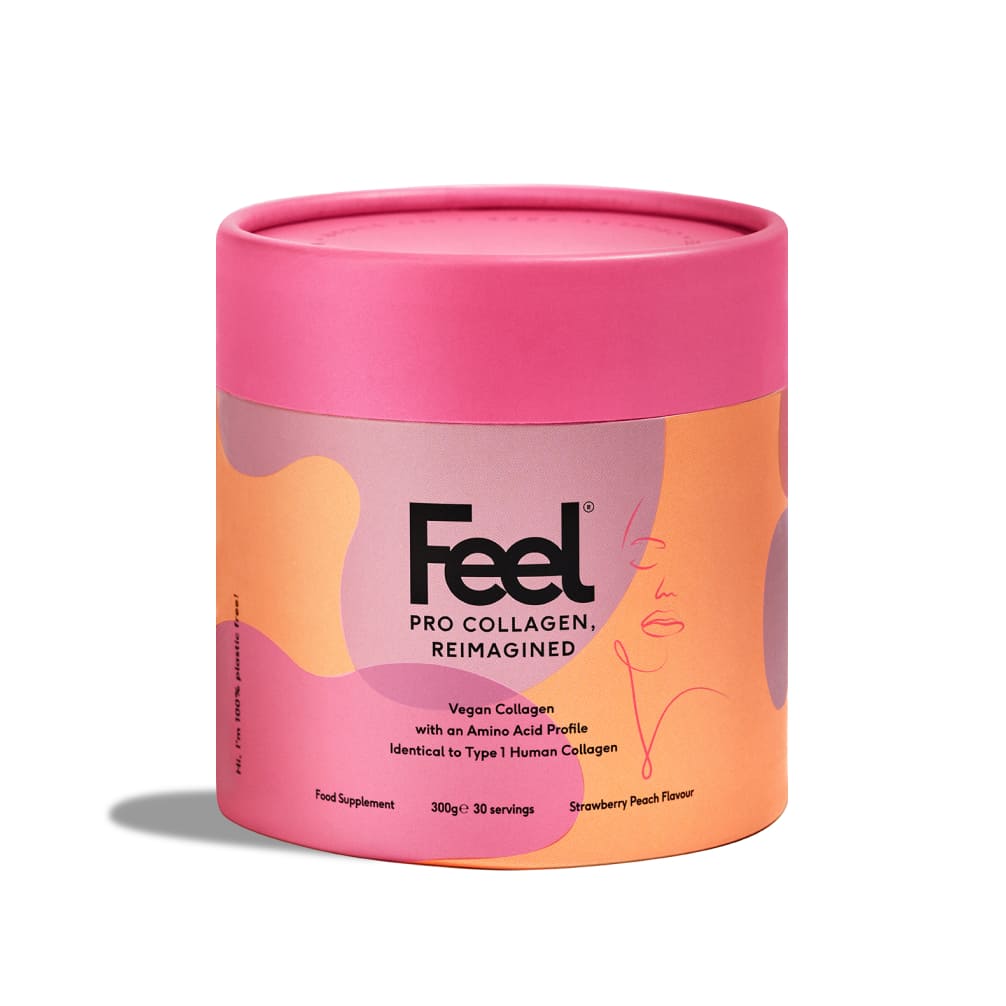
Pro Collagen Peach
The only vegan collagen powder on the market built on VeCollal — the patented, peer-reviewed biomimetic that matches human Type I collagen exactly. Strawberry-peach or pineapple-grapefruit flavour. 10g daily serving. 30 servings per tub.
20% off your first order · Cancel anytime online

The evidence behind every claim.
This investigation draws on peer-reviewed medical literature, clinical trial publications, institutional position statements, and comparative studies.
- Lin, Y.-K. et al. (2024) — "Oral supplementation of vegan collagen biomimetic has beneficial effects on human skin physiology." Journal of Functional Foods, 112: p.105955.
- Talnikar, H. et al. (2025) — "Comparative Efficacy of Recombinant Vegan and Marine Collagen." International Journal of Clinical and Medical Case Reports.
- VEGCOL clinical trial — "Revitalizing skin, hair, nails, and muscles: Unlocking beauty and wellness with vegan collagen." PubMed, 2024.
- Kuehn et al. (2020) — "Collagen: An Important Fish Allergen for Improved Diagnosis." Journal of Allergy and Clinical Immunology: In Practice.
- Harvard T.H. Chan School of Public Health — Collagen supplement position statement.
- Cleveland Clinic Health Essentials — "What Happens When You Take Collagen Supplements?"
- MD Anderson Cancer Center — Patient education resource on collagen supplementation.